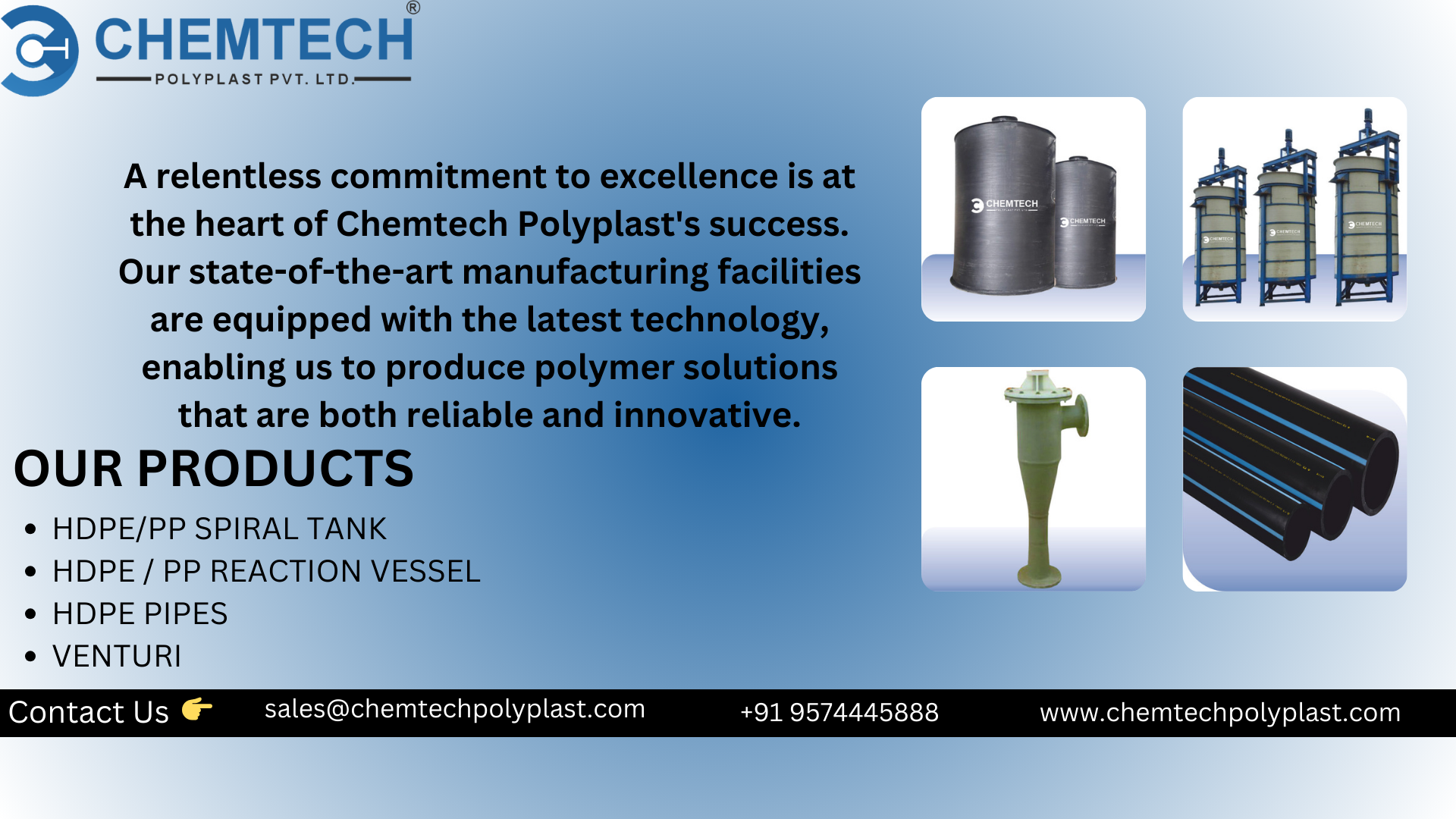
Introduction — High-Performance HDPE Pipe Manufacturer in Gujarat
As a leading manufacturer and supplier in Ahmedabad, Chemtech Polyplast delivers high-density polyethylene (HDPE) pipes specifically engineered for durable industrial applications across Gujarat. Our PE80 and PE100 grade pipes are the preferred choice for sectors requiring robust, corrosion-resistant, and leak-proof fluid transfer systems. Manufactured using state-of-the-art extrusion technology and certified raw materials, our HDPE pipes ensure exceptional longevity and performance in chemical plants, water treatment facilities, and effluent disposal networks.
Superior Durability and Chemical Resistance
The core advantage of our industrial HDPE pipes lies in their superior durability, designed to withstand the harsh operating conditions common in Gujarat's industrial belt. They are inherently resistant to corrosion, rust, and chemical attack from acids, bases, and common industrial effluents, making them far superior to traditional metal piping. The smooth inner surface prevents scaling and tuberculation, maintaining high flow capacity and efficiency over a service life often exceeding 50 years. Our pipes are also highly resilient to impact and ground movement, ensuring system integrity and minimizing maintenance.
Industrial Applications — Durable HDPE Pipes
- Chemical fluid transfer & process piping.
- Industrial effluent treatment plant (ETP) lines.
- High-pressure water supply & cooling water systems.
- Slurry and abrasive material transfer lines.
- Gas distribution networks (low & medium pressure).
Key Features — Industrial HDPE Pipes
- Exceptional corrosion and chemical resistance.
- Leak-free monolithic joints via heat fusion.
- High impact strength and abrasion resistance.
- Flexibility to withstand ground shifts and surges.
- Smooth internal bore for superior flow dynamics.
Specific Applications in Gujarat's Industries
- Serving GIDC estates with reliable, non-corrosive water and utility lines.
- Transportation of treated and untreated effluents in chemical and textile industries.
- Potable and non-potable water distribution in large factory premises and townships.
- Piping for industrial processes involving aggressive chemicals and solvents.
Core Advantages for Industrial Users
- Reduced system leaks and resource loss due to fusion-welded joints.
- Minimal maintenance costs over a long operational lifespan (50+ years).
- Low friction loss lowers pumping energy consumption.
- Easy and quick installation owing to lightweight and flexible material.
- Resistance to microbial growth, ensuring fluid purity for process water.
HDPE Pipe Manufacturing Standards and Grades
Chemtech Polyplast manufactures durable HDPE pipes in compliance with national and international standards like IS 4984 and ISO 4427. We offer PE80 and PE100 material grades in various Standard Dimension Ratios (SDR) and pressure ratings (PN 2.5 to PN 16) to match diverse industrial requirements. Our in-house quality control ensures consistent wall thickness, dimensional accuracy, and superior hydrostatic strength, providing clients across Gujarat with a reliable, high-performance piping solution for critical infrastructure projects.
Installation & Handling Tips — HDPE Pipes
- Ensure fusion surfaces are clean and dry before welding.
- Follow correct butt fusion or electro-fusion parameters (time/temperature).
- Avoid deep scratches or kinks during handling and laying.
- Store pipes on flat ground, away from sharp objects and direct heat.
- Allow for thermal expansion/contraction during above-ground installation.
FAQs — Durable Industrial HDPE Pipes
1. What makes HDPE pipes suitable for corrosive industrial fluids?
+
HDPE is a thermoplastic polymer that is chemically inert. This means it does not react with a wide range of acids, bases, and aggressive industrial chemicals, preventing internal and external corrosion that affects metal pipes.
2. Which grades of HDPE pipe are used for industrial pressure applications?
+
We primarily supply PE80 and PE100 grades. PE100 has superior strength and is typically used for higher pressure applications (like PN10 and PN16) and larger diameters, offering better performance with a thinner wall thickness.
3. What is the standard joining method for industrial HDPE pipe systems?
+
Heat fusion—specifically butt fusion (for larger pipes) or electro-fusion (for fittings and complex networks)—is the standard. This technique creates a strong, homogenous, and completely leak-proof joint that is often stronger than the pipe itself.
4. Can HDPE pipes be used for above-ground applications in a plant environment?
+
Yes, industrial HDPE pipes can be used above ground. We recommend UV-stabilized black pipe variants and proper support to manage thermal expansion, ensuring long-term performance under sunlight and varying temperatures.
5. What is the expected service life of industrial HDPE pipelines?
+
When properly installed for the intended application and pressure rating, durable HDPE pipes have an expected service life of 50 to 100 years, providing a highly cost-effective and long-lasting solution compared to traditional materials.