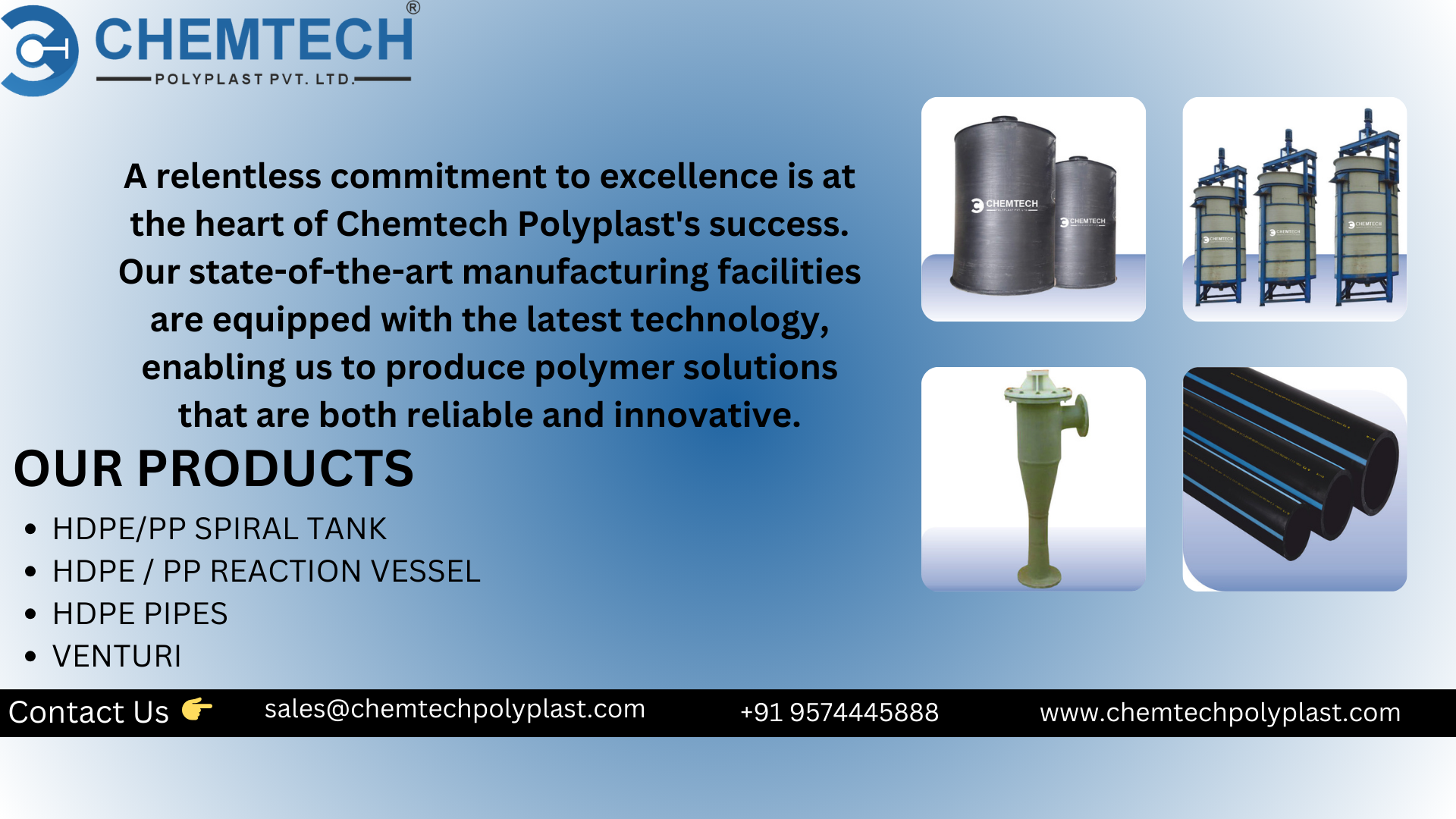
Introduction — Top Supplier of HDPE Pipes for Water Supply in Ahmedabad
Chemtech Polyplast is a leading manufacturer and supplier of high-quality HDPE Pipes for Water Supply in Ahmedabad and across Gujarat. Our High Density Polyethylene pipes are specifically engineered to meet the stringent demands of municipal and rural drinking water projects, conforming strictly to IS 4984 standards. These pipes offer superior resistance to corrosion, chemicals, and abrasion, ensuring a long-lasting and maintenance-free solution for potable water distribution networks. We provide a full range of pressure ratings (PN) and diameters tailored for critical water infrastructure.
Working Principle and Process Flow of HDPE Water Pipes
HDPE pipes function as a robust, non-corrosive conduit for fluid transport under pressure. Manufactured via continuous extrusion of high-grade PE compound, they offer superior flow characteristics due to a smooth internal bore, minimizing head loss and pumping costs. The pipe segments are joined seamlessly using heat fusion (butt fusion or electrofusion), creating a leak-proof, monolithic pipeline system that can withstand soil movements and high internal pressure surges—essential for reliable municipal and industrial water supply in the Ahmedabad region.
Applications — HDPE Pipes (Water Supply)
- Municipal water distribution lines and trunk mains.
- Rural water supply schemes and overhead tank connections.
- Potable drinking water projects (Jal Jeevan Mission).
- Submersible pump discharge and borewell column piping.
- Effluent and wastewater disposal lines.
Key Features — Water Supply HDPE Pipes
- Conforms to Indian Standard IS 4984 for potable water.
- Excellent resistance to corrosion and chemical attack.
- High durability and impact strength, minimizing breakages.
- Flexible, allowing installation around natural contours.
- Superior joint strength via butt fusion or electrofusion.
Specific Uses in Ahmedabad’s Infrastructure
- New municipal water line installation in expanding urban zones.
- Replacement of old, corroded pipelines in city networks.
- Piping for industrial water distribution in GIDC areas.
- Connecting water treatment plants to distribution pumping stations.
Core Advantages of HDPE Water Supply Pipes
- Zero leakage due to heat-fused joints ensures water conservation.
- Long service life, often exceeding 50 years, reducing replacement costs.
- Resistance to tuberculation and deposits maintains high flow rate.
- Lightweight and easy handling reduces installation time and effort.
- Non-toxic and suitable for safe, long-term drinking water transport.
Your Trusted HDPE Pipe Manufacturer and Supplier in Ahmedabad
Chemtech Polyplast is recognized as a trusted partner for HDPE Pipes for Water Supply in Ahmedabad. We utilize certified grade raw materials and advanced extrusion technology to produce pipes that meet the exact specifications of IS 4984 and client project demands. Our commitment to quality ensures every pipe is robust, dimensionally accurate, and capable of high-pressure performance in demanding environments. For reliable, maintenance-free water infrastructure solutions in Gujarat, partner with us.
Installation & Handling Tips — HDPE Pipes
- Ensure pipe fusion surfaces are clean, dry, and correctly aligned.
- Handle pipes carefully to prevent deep scratches or kinks.
- Follow manufacturer’s guidelines for fusion parameters (time/temperature).
- Install pipes below the frost line and protect from sharp objects.
- Perform pressure testing as per standard guidelines before commissioning.
FAQs — HDPE Pipes for Water Supply (Ahmedabad)
1. What pressure ratings (PN) are available for water supply?
+
We supply a full range of pressure nominal (PN) ratings including PN 2.5, PN 4, PN 6, PN 8, PN 10, and PN 12.5, suitable for different network pressures and project requirements.
2. Do these HDPE pipes conform to the standards for drinking water?
+
Yes, our HDPE pipes for water supply strictly comply with IS 4984:2022 and are made from food-grade material suitable and safe for the conveyance of potable drinking water.
3. What is the preferred method for joining HDPE pipes?
+
The most reliable method is heat fusion, either butt fusion (for larger diameters) or electrofusion (for critical joints or smaller lines), which creates a homogenous, leak-proof joint.
4. Are HDPE pipes resistant to hard water conditions in Ahmedabad?
+
HDPE pipes are fully resistant to the chemical effects of hard water and mineral deposits. Unlike metal pipes, they do not corrode or scale internally, maintaining their flow capacity.
5. Can these pipes be used for drainage or sewage applications?
+
While primarily designed for pressure water supply, HDPE pipes can be adapted for sewage, drainage, and industrial effluent, given their chemical resistance and flexibility.